Business & Tax Restructuring – When Does an IKE Make Sense and When Should You Choose an S.A.? 2026 Guide
A business may have started years ago with two people, limited capital and a relatively simple operating model. Today, however, it may have significant turnover, employees, bank financing, investments, new business partners and plans to bring in an investor.
At that point, a reasonable question arises:
Is the legal form chosen when the business was established still the right one today?
The answer is not simply a matter of tax rates.
Tax and corporate restructuring becomes relevant when a company’s existing legal structure no longer serves its size, management model and future growth plans.
For many Greek SMEs, the first decision is whether to move from a sole proprietorship to a corporate structure.
Once the business already operates through a company and continues to grow, however, a different question emerges:
IKE or S.A.?
The answer is not simply that “an S.A. is for large companies” or that “an IKE is cheaper”.
There are businesses with significant turnover that operate perfectly effectively as an IKE. There are also cases where converting into an S.A. becomes a logical next step.
The key is to understand when there is a genuine business reason for making that change.
1. What Does “Business Restructuring” Mean in Practice?
Restructuring does not necessarily mean that a company is facing a problem.
Quite often, the opposite is true.
The business has grown, while its original corporate structure has failed to evolve with it.
This may happen when:
- turnover and profitability increase significantly;
- new shareholders or partners join the business;
- a strategic or financial investor is expected to enter;
- financing requirements increase;
- a professional management team is being developed;
- the company expands into new markets;
- acquisitions or new investments are planned;
- a future sale of the business is being considered;
- a clearer separation between ownership and management is required.
At this stage, the question should not simply be:
“How much tax does an IKE pay and how much does an S.A. pay?”
The better question is:
“Which corporate structure can best support the business we want to have five years from now?”
That is essentially the starting point of a serious corporate restructuring exercise.
2. IKE and S.A. Are Not Simply Different in Terms of Size
The IKE — Private Company (Ιδιωτική Κεφαλαιουχική Εταιρεία) — has become one of the most practical corporate forms for businesses operating in Greece.
It is flexible, can be incorporated with very limited capital and allows for a relatively straightforward corporate structure.
The Greek S.A. — Société Anonyme (Ανώνυμη Εταιρεία) — on the other hand, is designed around a more structured capital and governance framework.
The minimum share capital of an S.A. is €25,000, whereas an IKE does not have a comparable substantive minimum capital requirement.
But this is not the most important difference.
In practice, the real distinction lies in corporate governance, ownership structure, decision-making processes and the mechanisms required when a business begins to have more shareholders or more complex relationships with investors.
An owner-managed business, where two or three shareholders are also the people managing the company on a daily basis, may operate extremely effectively as an IKE.
The discussion changes when ownership begins to separate from management, when different groups of shareholders emerge, or when an external investor requires specific rights and control mechanisms.
3. When Does an IKE Remain the Right Choice?
There is a common perception that a successful IKE “eventually needs to become an S.A.”
There is no such general rule.
If an IKE continues to serve the business effectively, there is little reason to increase administrative costs and complexity simply to operate under a different corporate form.
Consider a service company with turnover of €1 million, two shareholders and 15 employees.
The two shareholders continue to manage the business themselves. There is no external investor, no significant capital raise is planned and the ownership structure remains straightforward.
The fact that turnover has reached €1 million does not, by itself, create a reason to convert the company into an S.A.
The IKE may continue to serve the business perfectly well.
This matters because many restructuring discussions begin from the wrong premise:
“We have grown, therefore we should become an S.A.”
A better starting point is:
“What exactly can our current corporate structure no longer accommodate?”
If there is no clear answer to that question, there may not yet be a genuine reason to convert.
4. When Does an S.A. Start to Make Business Sense?
The discussion around an S.A. becomes more relevant when a company begins moving away from the owner-manager model towards a more structured corporate model.
A typical example is the introduction of an investor.
Assume that an IKE is owned 70% by its founder and 30% by a second shareholder. The company is growing and an investor is interested in investing €2 million in return for a significant equity stake.
The discussion is no longer limited to the percentage the investor will acquire.
The investor may require:
- participation in management;
- specific information rights;
- approval rights over material transactions;
- mechanisms protecting the investment;
- arrangements governing future capital increases;
- restrictions or rules governing transfers of shares;
- a defined exit mechanism.
In this environment, an S.A. can provide a more familiar and institutionally structured framework.
This does not mean that an investor cannot invest in an IKE. They can.
It means that as the investment relationship becomes more complex, a corporate form designed to accommodate a more sophisticated ownership and governance structure may become increasingly valuable.
5. IKE or S.A.: Taxation Is Not What Fundamentally Separates Them
One of the first questions raised when considering the conversion of an IKE into an S.A. is whether an S.A. enjoys more favourable taxation.
At the level of corporate income taxation, the answer is essentially no.
Both IKEs and S.A.s are subject to the same general corporate income tax rate, which for 2026 is 22%.
For example, if an IKE and an S.A. each report €300,000 of taxable profits, the corporate income tax liability, before any specific tax adjustments, would be:
€300,000 × 22% = €66,000
Similarly, where profits remaining after corporate income tax are distributed to shareholders as dividends, the general dividend tax rate currently applicable is 5%.
An S.A. is therefore not, by itself, a “more tax-efficient” version of an IKE.
This is important because a conversion should not be based on the expectation that simply changing the company’s legal form will automatically reduce the tax payable on its business profits.
The real differences between the two structures lie elsewhere: in management, corporate governance, ownership structure, the admission of new investors, capital increases and, more generally, how the business is intended to be organised as it grows.
There are, of course, individual tax and social security considerations that can affect the overall position of the individuals behind the company. One example is the remuneration of management and the social security treatment of an IKE manager compared with members of the Board of Directors of an S.A.
These matters, however, must be considered on the basis of the actual ownership and management structure of each company rather than being treated as a general “tax advantage” of one legal form over another.
Therefore, if an IKE operates effectively and meets the requirements of its shareholders, there is no tax reason to convert it into an S.A. merely because its turnover or profits have increased.
A conversion into an S.A. starts to make sense when the underlying business requirements change: where a different governance model is required, investors are entering the company, the shareholder base becomes larger or more complex, or the company is preparing for a different stage of growth.
Put simply:
The basic tax rate is not what separates an IKE from an S.A. The real distinction lies primarily in how the owners want to organise, finance and develop the business.
6. Dividends, Management and Social Security Contributions
Another point requiring careful consideration is how the owners participate in management and receive money from the company.
In an IKE, the manager plays a central role in the company’s operations. Under the applicable social security rules, an IKE manager is subject to mandatory social security as a self-employed person. The same applies to the sole shareholder of a single-member IKE.
The position in an S.A. is different and depends on the individual’s status, shareholding, membership of the Board of Directors and method of remuneration.
For example, members of the Board of Directors of an S.A. who hold at least 3% of the company’s share capital fall within the relevant categories of persons insured as self-employed.
A conversion into an S.A. should therefore not be approached on the simplistic assumption that:
“We will become an S.A. and EFKA contributions will disappear.”
Before making any change, it is necessary to map out who will be a shareholder, who will exercise management responsibilities, who will receive remuneration and in what capacity.
The same applies to dividends and management remuneration. A proper comparison should consider the overall net result for both the company and its shareholders, rather than focusing on a single tax rate.
7. The Additional Cost of an S.A. Should Deliver Business Value
A more structured corporate framework comes with additional costs.
An S.A. requires greater corporate discipline, more systematic corporate procedures and corresponding accounting and legal support.
This is not necessarily a disadvantage where there is a genuine need for such a structure.
For a company managing significant capital, with multiple shareholders, professional management or preparations for a major investment, increased corporate organisation may be exactly what the business requires.
For a business with two owners who continue to make all major decisions between themselves and do not anticipate any material change in ownership or governance, the additional complexity may simply create unnecessary cost.
A useful way of approaching the decision is therefore:
An S.A. should solve a genuine business problem or support a specific strategic objective.
“Prestige” alone is not a sufficient reason for restructuring.
8. When an Investor Enters, Corporate Structure Matters More
The introduction of an investor is perhaps the clearest point at which a company should reassess its corporate structure.
Until then, the founder may have exercised almost complete control over the company. Following the investment, a new balance is created.
An investor will not look only at turnover and EBITDA.
They will review contracts, outstanding tax matters, receivables, liabilities, corporate resolutions, intellectual property, related-party transactions and whether the company’s actual operations are consistent with what is reflected in its books, records and contractual arrangements.
In other words, the company will undergo due diligence.
If there are material weaknesses in the corporate structure, they often become apparent only after the investor has already entered negotiations.
At that stage, time is rarely on the entrepreneur’s side.
A company that knows it may seek financing or admit a strategic investor within the next two or three years therefore has a reason to prepare earlier.
In this context, restructuring is not a tax device.
It is about investment readiness.
9. Three Practical Business Examples
The distinction becomes clearer through practical examples.
Example 1 – IKE with €150,000 of Annual Profits
A consulting company has two shareholders, 10 employees and annual profits of approximately €150,000.
Both shareholders are actively involved in managing the business. There is no external investor and no planned capital raise.
Should the company become an S.A. simply because its profits have reached €150,000?
Not necessarily.
If the IKE adequately serves the company’s management and ownership requirements, converting it may offer little additional value.
The more relevant discussion may instead concern profit distributions, manager remuneration, reinvestment and the overall tax planning of the business and its shareholders.
Example 2 – €1.5 Million Turnover and €300,000 Profit
The second company has turnover of €1.5 million, profits of €300,000, 30 employees and three shareholders.
It is planning a significant investment, considering bank financing and one of the founders intends gradually to step away from the day-to-day management of the business.
Here, an S.A. starts to become more relevant.
Not because turnover has exceeded some “magic” threshold.
But because the management model itself is changing.
The company may now require a clearer separation between shareholders and management, a more structured corporate framework and potentially a different future ownership structure.
Example 3 – €2 Million Investor Entry
A growing company is in discussions with an investor who intends to invest €2 million through a capital increase.
Before completing the transaction, a number of matters should be considered:
the corporate form, valuation, post-investment ownership percentages, investor rights, management structure, future capital increases and the exit mechanism.
A potential conversion into an S.A. should not be considered in isolation.
It forms part of the overall transaction structure.
This leads to one of the most important principles:
Design the transaction first and then select the corporate structure that best supports it — not the other way around.
10. When Is There No Need to Convert an IKE into an S.A.?
Tax and corporate advisory should not always lead to more companies and more complicated structures.
There are many cases where the best advice may simply be:
“Do not change anything yet.”
If the business has a limited number of shareholders, operates efficiently, is not seeking an investor, has no material financing constraints and does not require more sophisticated governance, an IKE may remain entirely appropriate even at a significant level of turnover.
This is particularly true for businesses where ownership and management remain substantially in the same hands.
Restructuring comes at a cost.
In addition to professional fees and formal corporate procedures, there is also an internal cost: management time, changes to processes, banking arrangements, contracts and systems.
There should therefore be a measurable or strategic benefit before undertaking the change.
11. From IKE to S.A.: A Conversion Requires Planning
Once it has been determined that an S.A. is the appropriate next corporate form, the process should not be treated as a simple change of company name.
The current Greek corporate framework governing transformations is primarily set out in Law 4601/2019, while the tax framework has changed significantly following Law 5162/2024.
Part D of Law 5162/2024 reorganised the system of tax incentives applicable to corporate transformations and consolidated a substantial part of the previously fragmented tax framework.
This has practical implications.
Before proceeding with a transformation, the following should be reviewed:
- the company’s net equity;
- the value of its assets;
- tax losses carried forward;
- reserves;
- depreciation;
- receivables and liabilities;
- existing contracts;
- the proposed new capital structure;
- the interests of the existing shareholders;
- the tax consequences of the transformation itself.
Where the conversion is intended to precede the entry of an investor, the restructuring should be designed together with the next transaction.
There is little value in completing a corporate transformation only to discover a few months later that the new capital structure does not support the transaction that follows.
12. IKE or S.A.? A Practical Decision Matrix
There is no mathematical formula that provides the answer. There are, however, useful indicators.
| Factor | IKE | S.A. |
|---|---|---|
| Owner-managed business | Highly suitable | Potentially unnecessary complexity |
| Small number of shareholders | Highly practical | Depends on requirements |
| Minimum capital | Very low | €25,000 |
| Simplicity of management | Greater | More structured corporate governance |
| Admission of a straightforward new investor | Yes | Yes |
| Complex investment structure | Possible | Often more suitable |
| Institutional / strategic investor | Possible | Often preferred |
| Separation of ownership / management | Possible | More natural corporate structure |
| Future financing / exit | Possible | May offer greater structural flexibility |
| Administrative cost | Usually lower | Usually higher |
The table should not be applied mechanically.
An IKE may in practice have a more complicated structure than a small S.A., while an S.A. may have a very straightforward ownership structure.
What matters is the actual business requirement.
13. Five Questions to Ask Before Any Restructuring
Before making a decision, we would ask five fundamental questions.
First: What problem in the current structure are we trying to solve?
Second: What do we expect the ownership structure to look like in three to five years?
Third: Will the company require external capital or a new investor?
Fourth: Will the owners continue to manage the business on a day-to-day basis, or is the objective gradually to separate ownership from management?
Fifth: Are there plans for new companies, acquisitions or separate business activities?
The fifth question is particularly important.
Because at that point, the appropriate solution may no longer be simply:
IKE or S.A.
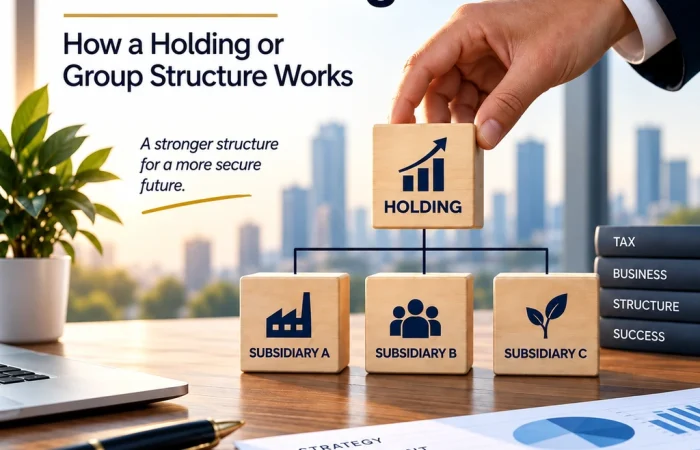
It may be necessary to consider establishing a Holding Company and a Group Structure.
That represents a different level of corporate planning and is examined separately in Part II of this series.
Conclusion
The decision between an IKE and an S.A. should not be based on the perceived prestige of the legal form, the company’s turnover or a single tax rate.
For many Greek businesses, an IKE can remain entirely appropriate even after the company has grown substantially.
An S.A. becomes more relevant where the business requires a more structured ownership and governance framework, where ownership begins to separate from management, where the company is preparing for significant financing, or where investors are entering with specific governance and exit requirements.
The key question is therefore not:
“When is my business large enough to become an S.A.?”
It is:
“Which corporate structure best supports the next stage of my company’s growth?”
The right time to answer that question is not after an investor has already begun due diligence or when financing is already at the final stage.
It is earlier.
TKC Consulting & Finance supports businesses in the design and implementation of corporate and tax restructurings, taking into account not only taxation but also ownership structure, financing, management, investor entry and the company’s next stage of growth.
TKC Consulting & Finance
Tax • Accounting • Business Advisory
This article is provided for general informational purposes only and does not constitute individual tax, legal or investment advice. The selection of a corporate form and the implementation of a corporate transformation should always be assessed on the basis of the specific facts and circumstances of each business.